

The International Energy Outlook is published by the US Department of Energy and contains valuable information about the energy industry’s future—including production and demand projections.
The 2019 report explores how industrializing countries and technological advancements are expected to increase both production and global consumption. Energy is the catalyst that fuels economies, so as nations invest in industrialization, the report predicts a 20% demand increase by 2050. The future for mineral owners with crude oil and natural gas resources is very bright.
NATURAL GAS: WHAT’S DRIVING GLOBAL DEMAND?
As the world retires coal-fired electricity production and gravitates to the relatively inexpensive option of natural gas generated power, the US will continue to grow as a net exporter. Asia and India are both primed to experience high industrial growth stages. Much of this growth will be powered by liquefied natural gas (LNG) strengthening the US net exporter position.
The US is projected to remain the top natural gas producer by increasing production by nearly 50% from 2018 to 2050 and creating 43 trillion cubic feet (Tcf) in 2050.
We’re not the only country looking to cash in on the international demand for LNG. Japan is investing $10 billion on LNG projects worldwide in preparation.
What does the global demand for natural gas and LNG mean for owners?
The capacity for gas production in the US is expected to rise by 70% by 2050, which means the shopping and the negotiating begins now.
Do you own natural gas resources? Whether your interests are working or not, pay strict attention to your lease agreements and take time to explore your options when opportunities arise. The demand spike may be thirty years away, but the industry players are already preparing to position themselves to deliver on the increase. Long-term leases may seem attractive, but value fluctuates with demand, so what may be an attractive agreement today, may feel criminal in ten years. Be wary of clauses that guarantee rights to renew or extend.
If you have natural gas resources, be prepared for phone calls, even if the resource dismissed in the past. Advancements in technological capabilities and infrastructure are generating interest in resources that were once passed over.
How do we know that industry is already deploying to meet the expected demand spike?
We’re working with clients who are already welcoming renewed interest in deposits. One client in particular had welcoming news that the natural gas deposit is significantly more substantial that previous research showed. That information coupled with strong pipeline infrastructure has generated new leases, production and planned wells.
The Appalachian region and Southwest are blessed with a wealth of resources, so if you own mineral rights in a “hot” area but are unsure of your status or your area’s players, it may be time to investigate. We can help owners by providing an area analysis and guided steps.
It’s important to work with someone you know and trust, so we offer prospective clients a complimentary consultation. You can be prepared for that phone call or letter by scheduling your first meeting today—simply share how you’d like to connect.
PETROLEUM & CRUDE OIL: HOW IS TECHNOLOGY TRANSFORMING EXPLORATION AND PRODUCTION?
The EIA reports that in 2018, the US produced 10,990,000 barrels per day, and that number is expected to grow. The report indicates that in OPEC countries alone, petroleum and crude oil production is expected to increase by 30%.
The Southwest is blessed with these resources as evident by the 2018 nationwide production numbers.
ANNUAL-THOUSAND BARRELS PER DAY 2018
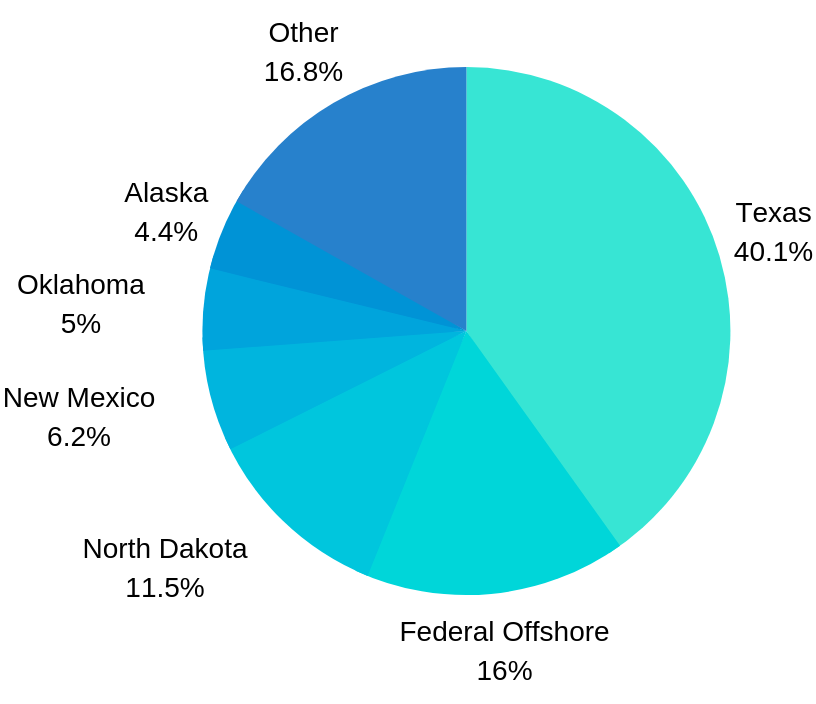
83% of the US production is credited to just 5 states and the federal offshore
While the US may have tighter reserves than some countries, identification of new oil fields combined with more efficient extraction methods like horizontal drilling, are enabling us to be more productive.
While oil rarely gets positive media attention, the industry is making significant strides with technological advances in mapping, drilling, and transporting. These advancements are making the resources more accessible and attractive. For example, US oil had a very exciting year with a major new find and updated projections:
Utica & Marcellus
The United States Geological Survey (USGS) recently updated the estimates of the Utica and Marcellus shale production. Utica is now expected to outperform Marcellus by producing 117.2 trillion cubic feet (Tcf), compared to an estimated 96.5 Tcf.
Wolfcamp & Bone Springs
Remember last Thanksgiving’s big news for the energy sector? The USGS published an assessment showing that the Wolfcamp Shale and overlying Bone Spring Formation, are technically recoverable reserves—and officially the world’s largest. They’re estimated at 46 billion barrels of oil, 280 Tcf of gas, and 20 billion barrels of natural gas liquids. Fast forward and permits are already filed to begin drilling targeting the Ford West field of Wolfcamp’s geological layer.
TECHNOLOGICAL ADVANCES ARE CREATING OPPORTUNITIES FOR OWNERS.
As technology strengthens and improves, so do your future earnings. Unidentifiable deposits are being found. Unreachable deposits are now attainable. Transporting product is now cheaper and safer.
The report’s research and information is powerful, so how can you put it to work for you?
Here’s how you can start:
1. Analyze your portfolio of working and non-working assets and leverage the research to support your management strategies. Have questions? Introduce yourself and let us provide clarity.
2. Facilitate a dialogue with stakeholders and help to keep them informed.
3. Share the article. Email it to a friend or share it with your LinkedIn and Facebook network.
We’ve entered the final quarter of 2019 and the next era of the energy industry. If you have questions about your assets, suspicions about your reports’ accuracy or are looking to strengthen your control—we’re here for you. Schedule a meeting today and subscribe to our monthly newsletter.